
'The price increases, particularly in respect of cooking gas, that is domestic LPG and PDS kerosene, have been quite minimal.'
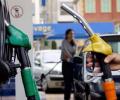
International oil prices surged close to $100 a barrel on Tuesday after Russian President Vladimir Putin sent troops into Ukraine, but petrol and diesel prices in India continue to be on freeze and are expected to rise once assembly elections in states like Uttar Pradesh end. Amid fears of supplies being disrupted because of Russian aggression, the price of futures contract for Brent crude oil with April delivery on London's ICE rose by 4.18 per cent to $99.38 per barrel on Tuesday morning, before paring some gains to settle just above $98. The last time Brent exceeded $99 per barrel was in September 2014. Russia makes up for a third of Europe's natural gas and about 10 per cent of global oil production.

How the UN's flagship climate summit lost its direction and what's at stake.

Lining up its 2030 strategy, Hyundai said it was targeting up to 30 per cent export contribution and over 1.5-fold rise in revenue, to cross the 1 trillion milestone in five years.

Empowered group of ministers on fuel pricing was likely to meet soon.

After prospects of a higher subsidy outgo on food and fertilisers, the government is faced with the spectre of a higher petroleum subsidy. Rising crude oil prices and its inability to increase fuel prices is all set to spoil the government's subsidy calculations. The country meets 80 per cent of its crude oil demand through imports.

Airfares on major domestic routes such as Kolkata-Bagdogra, Delhi-Bengaluru, and Delhi-Mumbai have witnessed an increase of up to 12.7 per cent year-on-year (Y-o-Y) in May this year, according to data by Thomas Cook (India) and SOTC Travel. The recent increase in aviation turbine fuel prices, rupee depreciation, reduction of flights by key players, and grounding of planes due to engine supply issues have contributed to the rise in airfares, said aviation industry experts. However, the data also shows that summer airfares on key routes such as Delhi-Leh and Delhi-Kolkata have significantly decreased due to the introduction of new flights.
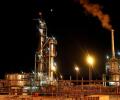
India, the world's third largest oil importing and consuming nation, is likely to save as much as Rs 1.8 lakh crore on import of crude oil and LNG if the trend of softening international energy rates continues, Icra said Wednesday. India, which meets over 85 per cent of its crude oil needs through imports, spent $242.4 billion on buying crude from overseas in the fiscal year ended March 31, 2025.

Trinamool Congress MPs are likely to meet Prime Minister Manmohan Singh in Delhi on November 8 against the backdrop of the UPA ally's threat to pull out of the government on the petrol price rise issue.

The government has to take a call on reducing or retaining the excise rate.

The world is in a state of crisis and it is difficult to predict how long this state of instability will last, Prime Minister Narendra Modi said on Thursday referring to various global challenges arising out of conflict, war and terrorism among others. In his opening remarks at the Voice of Global South virtual summit, Modi flagged concerns over rising prices of food, fuel and fertilisers, economic impact of the COVID-19 pandemic as well as natural disasters driven by climate change. "We are meeting as a new year dawns and brings new hopes and new energy," Modi said.

Taming the animal called AI in its many avatars will clearly remain a work in progress.
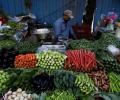
The wholesale price-based inflation bucked the 4-month rising trend in December 2021, and eased to 13.56 per cent, mainly on account of softening in fuel, power and manufacturing items even though food prices hardened. WPI inflation has remained in double digits for the ninth consecutive month beginning April. Inflation in November was 14.23 per cent, while in December 2020 it was 1.95 per cent.

The wholesale price-based inflation stood at 12.13 per cent during the corresponding week a year ago.

Rising fuel prices, intense competition and inability to pass on spiralling expenses have been negatively impacting the domestic airlines.

The Indian men's skeet team stayed back to participate in their event

Flagging higher fuel prices in many opposition-ruled states, Prime Minister Narendra Modi on Wednesday called it "injustice" to people living there and urged the governments there to reduce VAT in "national interest" to benefit the common man. Modi raised the issue of many states not adhering to the Centre's call for reducing the Value Added Tax (VAT) on petrol and diesel after his government slashed excise duties on them in November last, and asked them to work in the spirit of cooperative federalism in this time of global crisis. Higher prices in some states were also harmful for neighbouring states, he added.
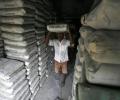
Even as cement companies continue to announce ambitious expansion plans, analysts turn cautious over the sector as incremental supply is expected to coincide with a weak demand growth period, and other headwinds of higher fuel costs, weak monsoons and general elections. In August, JSW Cement said it will take its current 19 million tonnes (MT) capacity to 60 MT in the next five years. The country's top producers have massive expansion plans underway - UltraTech Cement targeting 200 MT, Adani Cement aiming for 140 MT and Dalmia Cement planning for 110-130 MT.
At one end the petrol motors have been criticised for consuming high fuel while on the other the diesel motors have also been condemned for being noisy and low powered.

He also alleged that those doing violence in the name of Hinduism are not Hindus but hypocrites.
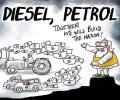
Petrol and diesel prices are unlikely to be increased despite firming raw material costs because of upcoming general elections next year, Moody's Investors Service said. Three state-owned fuel retailers -- Indian Oil Corporation (IOC), Bharat Petroleum Corporation Ltd (BPCL) and Hindustan Petroleum Corporation Ltd (HPCL) -- which control roughly 90 per cent of the market, have kept petrol and diesel prices on freeze for a record 18 months in a row. This is despite the raw material (crude oil) cost surging last year, leading to heavy losses in first half of 2022-23 fiscal year before easing oil prices propelled them to profitability.
The Communist Party of India on Friday said the Left will move an adjournment motion in the Winter Session of Parliament on the price rise issue as it accused the United Progressive Alliance government of not being able to control double-digit inflation and demanded deregulation of fuel prices.

Sources said the issues to be raised during the monsoon session of Parliament starting July 19 were discussed at a meeting of the Congress parliamentary strategy group on Wednesday, which was chaired by party chief Sonia Gandhi and attended by former prime minister Manmohan Singh and former Congress president Rahul Gandhi.

How is it that tomatoes recorded a price fall in official statistics when it remained unaffordable for the common person in June?

Stock investors will track the ongoing conflict between Iran and Israel, Brent crude oil prices, inflation data and the US Fed interest rate decision for further cues this week, analysts said. Tariff-related news would also dictate trends in the equity market, experts noted.

Reliance Industries Ltd on Thursday reported a 7.4 per cent rise in its December quarter net profit, as its retail business rebounded and telecom earnings rose. Its consolidated net profit of Rs 18,540 crore, or Rs 13.70 per share, in October-December - the third quarter of April 2024 to March 2025 fiscal (FY25) - compared to Rs 17,265 crore, or Rs 12.76 a share, in the same period a year back, according to a stock exchange filing by the company.
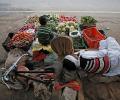
The spike in food prices at the onset of the monsoon season has corroborated the Reserve Bank of India's (RBI's) view that the fight against inflation is far from over, the State of the Economy report of the central bank said. At the same time, the report said that the country is poised to become the fastest-growing major economy in the world, notwithstanding some sequential moderation in economic activity in June. Consumer Price Index (CPI)-based inflation rate increased to 4.8 per cent in June 2023, from 4.3 per cent in May, primarily on account of an increase in food inflation.

The Reserve Bank on Friday raised the inflation projection for current fiscal year to 4.8 per cent from 4.5 per cent with Governor Shaktikanta Das saying lingering food price pressures are likely to keep headline inflation elevated in the December quarter. Consumer price index (CPI)-based inflation increased sharply in September and October 2024 led by an unanticipated increase in food prices.
The government is planning a moderate hike of Rs 1-1.50 per litre in the prices of petrol and diesel in view of the rising global crude tags.
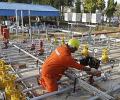
The 62 per cent increase in natural gas prices by the Indian government will boost the profitability of upstream companies in the country and support their investment spending, Fitch Ratings said on Tuesday. The price for gas from fields that were assigned by the state to oil companies, mainly Oil and Natural Gas Corporation (ONGC) and Oil India Ltd (OIL), increased to $2.90 per million British thermal units (mmBtu) for October 2021-March 2022, from $1.79 per mmBtu in the previous six months. "Higher gas prices will increase the input cost for key end-consumer sectors, to the extent the price hike is passed on," Fitch said.
Jet Airways and Kingfisher Airlines may move towards a second round of mergers and acquisitions as smaller low-cost airlines and other rivals, hurt by rising fuel prices, seek an exit from the business to cut losses, an industry expert said. State-run oil firms have hiked jet fuel (aviation turbine fuel) prices by 18.5 per cent in line with rising international crude oil prices.
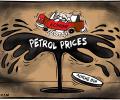
A proposal in the Union Budget 2022-23 to raise excise duty on dirtier, unblended retail petrol and diesel has met with some resistance from the petroleum ministry. However, finance ministry officials say no such communication arguing against the levy of extra duty on diesel has been received from the oil ministry. Until there are discussions between the two departments, the proposal will not be tweaked in the Finance Bill. The Rs 2 per litre additional excise duty proposed on unblended fuels in the Finance Bill will result in a uniform hike of diesel prices across the country from October 1.

India's fuel sales surged past pre-pandemic levels in March on twin impact of the economy rebounding from the lifting of pandemic-related restrictions and anticipation of price increases leading to stocking. In the first two weeks of March, dealers, as well as the public, topped up their tanks in anticipation of an increase in prices that had been on hold in the run-up to the elections in states like Uttar Pradesh. While daily price revisions restarted on March 22, the increases were calibrated.
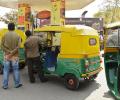
CNG and piped cooking gas prices in cities such as Delhi and Mumbai may be hiked by 10-11 per cent next month as the government-dictated gas price is set to rise by about 76 per cent, ICICI Securities said in a report. The government, using rates prevalent in gas-surplus nations, fixes the price of natural gas produced by firms such as state-owned Oil and Natural Gas Corp (ONGC) from fields given to them on nomination basis, every six months. The next review is due on October 1.
Petrol and diesel prices were cut by Rs 2 per litre each as state-owned oil companies ended a nearly two-year-long hiatus in rate revision, just hours before the general election schedule was announced.

State-owned oil firms on Friday hiked jet fuel prices by almost 2 per cent, the sixth straight increase in rates since October when international crude oil prices started climbing.
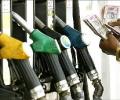
New chief statistician T C A Anant said on Monday hiking fuel prices was a better option than keeping them artificially low and widening the fiscal deficit, even as the Opposition organised a nationwide strike against the government's decision on Monday.
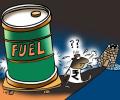
Inflation in 'fuel and power' basket rose sharply to 11.22 per cent in May from 7.85 per cent in April as prices of domestic fuel increased in line with rising global crude oil rates.

Corporate earnings got a big boost from the fall in commodity and energy prices in July-September 2023 (Q2FY24) despite a slowdown in revenue growth during the quarter. The combined net profits of 3,123 firms that have declared their results so far were up 38 per cent year-on-year (Y-o-Y) to Rs 3.07 trillion in Q2FY24, up from Rs 2.24 trillion a year ago. Earnings were, however, down 3.5 per cent on a sequential basis from Rs 3.18 trillion in April-June (Q1) FY24.
